The Mini Goldendoodle.
A Golden Retriever’s heart in a Poodle’s coat, at a size that fits a lap, a car seat, and a small house.
Ours are a Mini Goldendoodle mother and a Mini Poodle father, so the puppies lean Poodle: curly, low-shedding coats and a quick mind, with the Golden’s steady affection. Here is what that means in a home, with the numbers behind it.

Grown, and still car-seat sized 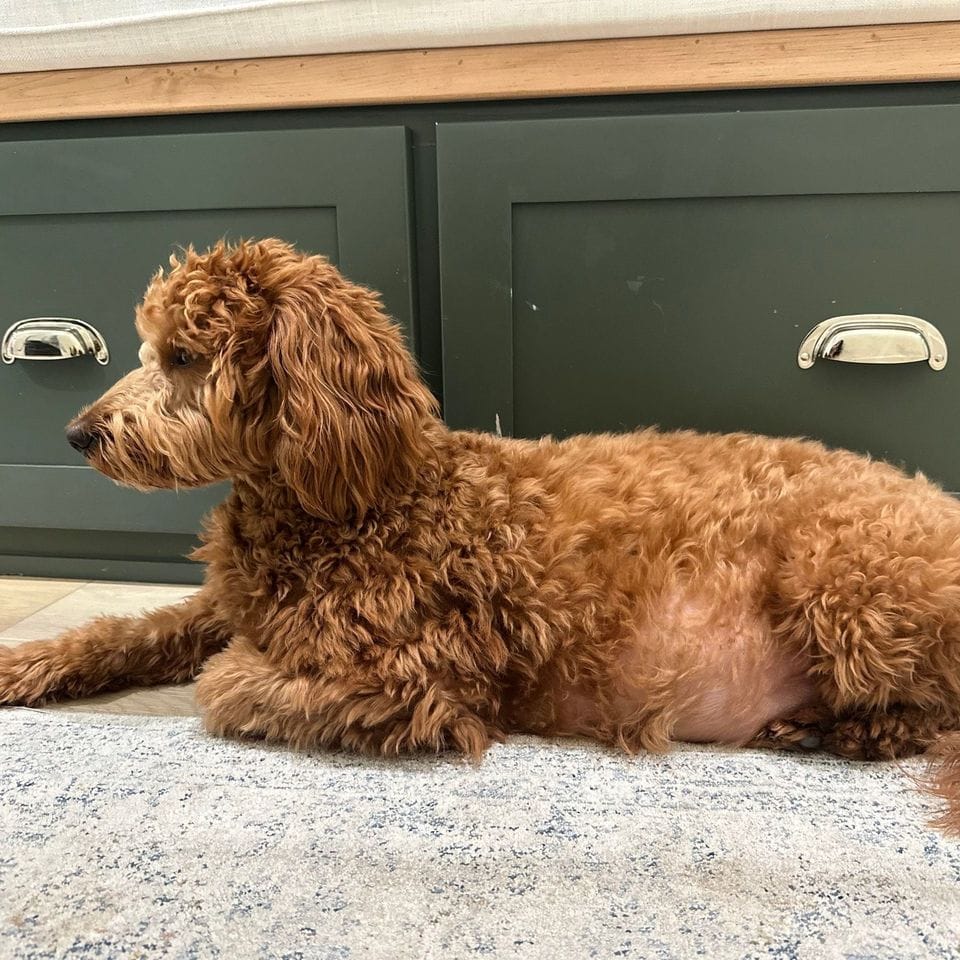
Settled


How big they get
The Goldendoodle Association of North America sorts the breed by adult height at the shoulder: Petite under 14 inches and about 25 lb or less; Miniature 14 to 17 inches and about 26 to 35 lb; Medium 17 to 21 inches and 36 to 50 lb; Standard over 21 inches and 51 lb up. Ginger’s Six are expected at 20 to 25 lb grown and Lacey’s Seven at 12 to 18 lb: the small end of the breed, the size that rides in a car seat and curls up on a couch without taking it over. A breeder’s size estimate is an educated guess from the parents; the dog decides at adulthood.1
How they think
In Stanley Coren’s ranking of 138 breeds by working and obedience intelligence, the Poodle sits second and the Golden Retriever fourth. In practice that is a puppy who learns its name in days, takes to a leash in a week, and wants to be in on whatever you are doing. The flip side of a quick mind is that it needs a job: a walk, a training game, a car ride to somewhere new. Both parent breeds are among the most-registered dogs in the country for the same reason; the Golden Retriever was the third most popular breed in 2024 and the Poodle fifth.2
The coat
Wavy to curly, with the beard and eyebrows that come from the Poodle side. A Poodle-forward cross like ours sheds very little, which is why so many allergy-sensitive families choose the breed; no dog is free of allergens, and the honest test is time spent with the puppy before you decide. The coat keeps growing, so plan on brushing a few times a week and a groomer every six to eight weeks.
How long they live, and what to check
Goldendoodles typically live 10 to 15 years. The conditions worth asking any breeder about come from the parent breeds: hip dysplasia, progressive retinal atrophy, and von Willebrand disease among them. DNA panels on the parents are how you know before you buy. Ours are public on the Parents page, with every finding explained in plain English.3
Why they are chosen for emotional support
This program started with research into emotional support dogs, before it was a business. The science is simple: in a 2019 Washington State University study of 249 students, ten minutes of petting dogs and cats produced a significant drop in cortisol, the main stress hormone. A Mini Goldendoodle is the breed people reach for because it is small enough to sit with you, calm enough to settle, and attached enough to notice when you need it. Under the federal Fair Housing Act, a housing provider must consider a reasonable accommodation for an assistance animal, including an emotional support animal, when a person with a disability has documentation from a health professional. An emotional support animal is not a service animal under the ADA, and since a 2020 Department of Transportation rule airlines are no longer required to carry them in the cabin.4
A day with one
Thirty to sixty minutes of walking or play, a few minutes of training, and a lot of company. They do not do well left alone all day; they do beautifully with a family that takes them along. Every puppy here rides in the car, walks on a leash, and sleeps in a crate before it goes home, so the first week with you starts from a routine, not from zero.
Sources
- 1Goldendoodle Association of North America: Goldendoodle Sizes
- 2Stanley Coren, The Intelligence of Dogs (breed rankings); American Kennel Club, Most Popular Dog Breeds of 2024
- 3Dogster (vet-verified): Goldendoodle size, weight and lifespan
- 4Washington State University, July 2019: stress reduction from petting dogs and cats (AERA Open); U.S. Department of Housing and Urban Development, Assistance Animals fact sheet; Federal Register, Traveling by Air With Service Animals (December 2020)
Meet ours.
Both litters are ready to go home now. Two minutes to apply, no payment, no commitment.
One of them is yours.
Apply in two minutes: your name, your number, and which puppy. No payment, no commitment. Or email bentonvilledoodles@gmail.com.
Questions? Email bentonvilledoodles@gmail.com